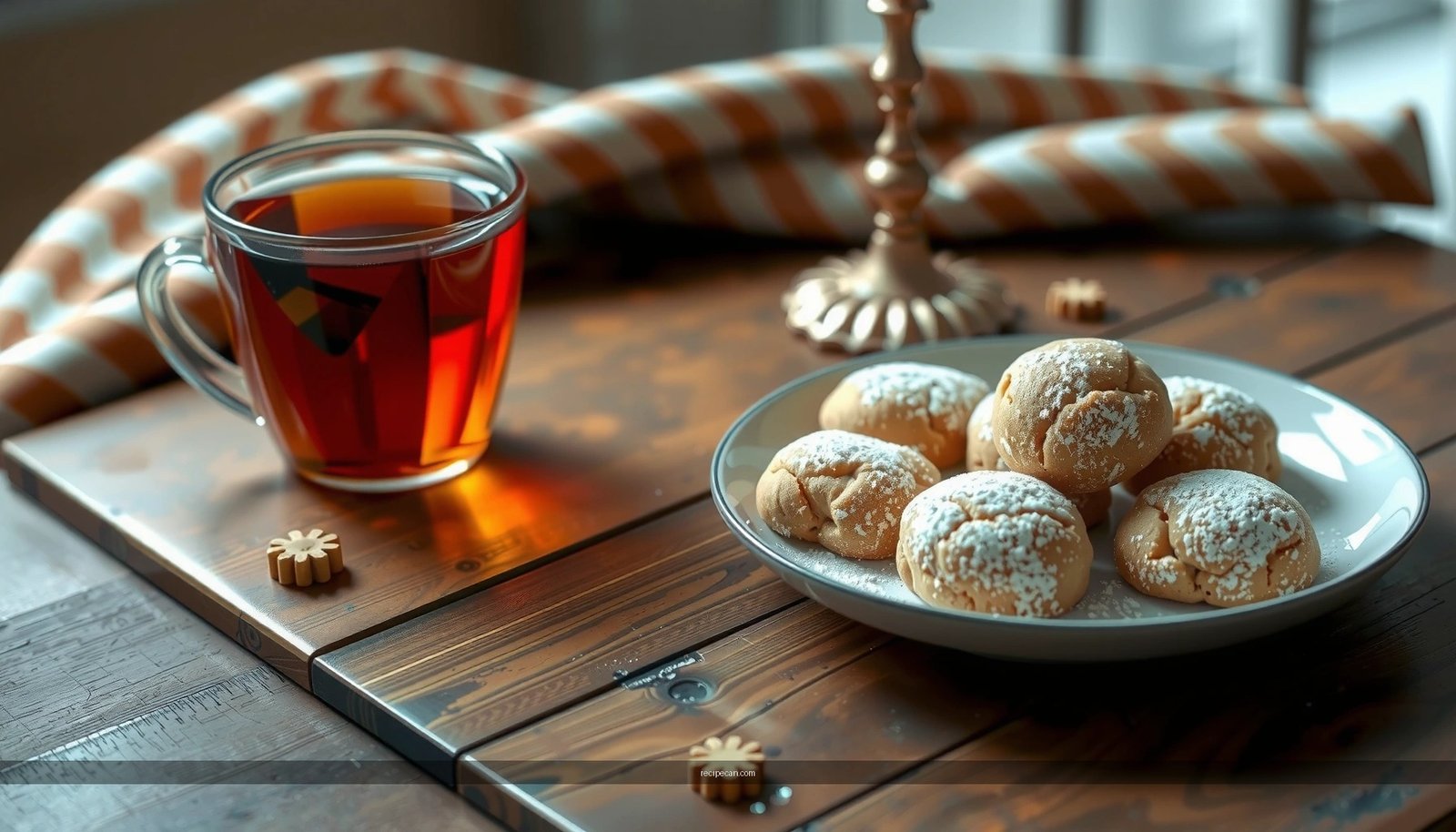
Get the Russian tea cookie recipe that delivers buttery, tender cookies with the unmistakable sweet-tart finish—without fuss. This easy classic method answers one question: how do you bake Russian tea cookies that hold their shape, stay melt-in-your-mouth soft, and come out perfectly dusted every time. Follow the simple steps and you’ll have a reliable batch whether you’re a first-time baker or returning for the old favorite.
Russian tea cookies are easy to bake: form the dough into small balls, roll them in powdered sugar before baking and again after they cool, and you’ll get that unmistakable “snowball” finish. Below is a reliable, step-by-step Russian tea cookie recipe with exact ingredients, clear timing, and doneness cues so the cookies turn out tender, buttery, and nutty every time.
In classic versions, these cookies are essentially a shortbread-style dough enriched with butter and chopped nuts (walnuts or pecans). The “snowy” look comes from powdered sugar adhering to warm cookies and then setting as the cookies cool—so temperature and handling are as important as the ingredients.
Ingredients for Russian Tea Cookies

– Use classic butter, powdered sugar, and nuts (walnuts or pecans) for traditional flavor
– Gather flour and optional vanilla or cinnamon for balanced sweetness
Russian tea cookies (often called Russian tea cakes or Mexican wedding cookies in some regions) depend on a short ingredient list, but the ratios matter. Here’s a dependable ingredient set for about 24–30 cookies (depending on how large you portion the dough balls):
– Unsalted butter (softened): 1 cup (226 g)
Provides structure and the melt-in-your-mouth texture.
– Powdered sugar: 1/2 cup (60 g)
Sweetens the dough while creating a tender crumb.
– Chopped nuts: 1 cup (100–120 g)
Walnuts or pecans both work; pecans tend to be slightly sweeter, walnuts deeper and earthier.
– All-purpose flour: 2 cups (250 g)
Gives the cookie dough its shape and “cookie” bite once baked.
– Salt: 1/4 tsp
Balances sweetness and makes the nut flavor pop.
Optional flavor boosters
– Vanilla extract: 1 tsp (recommended)
– Cinnamon: 1/2 tsp (optional)
A light dusting of cinnamon harmonizes with the nutty profile without turning the cookies into something spice-heavy.
For rolling
– Extra powdered sugar: about 1–1 1/2 cups (120–180 g), for pre-bake and post-bake rolling
The amount you need depends on how generously you coat and how warm the cookies are when you do the second roll.
Why these ingredients work (quick, practical chemistry)
– Butter + powdered sugar create a tender dough because powdered sugar dissolves more easily than granulated sugar during mixing.
– Nuts provide both flavor and fat; they also add tiny “crumb particles” that enhance the cookie’s melt and crumb.
– Flour amount ensures the dough holds its shape long enough to become a stable, snowy shell around a soft interior.
Russian Tea Cookies: Doneness Targets for Best Texture
| # | Baking Cue | What You Should See | Target Range | Result |
|---|---|---|---|---|
| 1 | Cookie set (bottom) | Edges look stable, bottom no longer glossy | 10–13 min @ 325°F | Ideal tenderness |
| 2 | Top appearance | Just beginning to look dry/matte | 10–14 min | Snow coat adheres |
| 3 | Center texture | Soft but not doughy | Firm after cooling | Clean bite |
| 4 | Color | Light golden underside; pale tops | Golden 1–2 shades | Avoids dryness |
| 5 | Overbake risk | Crackly surface, darker edges | >14–16 min | Less tender crumb |
| 6 | Undercook risk | Glossy tops/bottoms | <9–10 min | Gummy center |
| 7 | Cooling window before final roll | Warm to touch but no longer hot | 5–10 min off oven | Dry, snowy finish |
Step-by-Step Russian Tea Cookie Dough
– Mix butter with powdered sugar until smooth, then add dry ingredients gradually
– Fold in chopped nuts and chill the dough if needed for easier shaping
This Russian tea cookie recipe is straightforward, but mixing order affects texture. Follow these steps for tender, nutty classic cookies.
1. Prep and measure
– Preheat oven to 325°F (163°C).
– Line baking sheets with parchment paper.
– Chop nuts finely—think “sand-like crumble with some small bits,” not nut flour or large chunks.
2. Cream butter and powdered sugar
– In a mixing bowl, beat softened butter and powdered sugar until smooth and lighter in texture (about 2–3 minutes).
– Scrape the bowl once to ensure no sugar pockets remain.
3. Add vanilla (and cinnamon, if using)
– Mix in vanilla (and cinnamon if desired).
– This is your flavor base—don’t skip it if you want bakery-style Russian tea cookies.
4. Incorporate flour and salt
– Whisk flour and salt together separately, then add to the butter mixture gradually.
– Mix just until you don’t see dry flour. Overmixing can lead to tougher cookies.
5. Fold in chopped nuts
– Stir nuts in by hand or on low speed until evenly distributed.
6. Chill if needed
– If dough feels soft or sticky, chill 20–45 minutes.
– Chilling makes shaping easier and helps prevent spreading—especially in warmer kitchens.
Analytical note: Because butter is the main fat in the dough, cookie shape depends on fat temperature. When butter warms during mixing, chilling re-stabilizes structure so the cookies hold their “ball” form.
Shaping and Rolling in Powdered Sugar
– Portion dough into small balls for even baking
– Roll in powdered sugar generously before baking and repeat after cooling
The “snowball” effect is not accidental—it’s a repeatable process. Here’s how to get the best coating.
1. Portion evenly
– Scoop dough and roll into 1-inch (2.5 cm) balls (slightly smaller for a larger yield).
– Place balls 1.5 inches apart on the baking sheet.
2. First powdered sugar roll (pre-bake)
– Roll each ball in powdered sugar, ensuring an even coat.
– Tip: If sugar clumps due to humidity, sift it.
3. Bake
– Bake at 325°F (163°C) for 10–14 minutes.
– The goal is a set bottom and tops that look just done (more on this below).
4. Second powdered sugar roll (post-bake)
– Let cookies cool on the tray 5–10 minutes, then roll again.
– This timing helps powdered sugar adhere without melting into a sticky glaze.
Why two rolls work: the first roll starts forming a sugar “shell” while the second roll rebuilds an even, snowy finish once the surface is cool enough to hold powder.
Baking Time and Doneness Tips
– Bake until the bottoms are lightly set and the tops look just done
– Cool on the tray briefly, then finish cooling to prevent sugar from melting
Baking Russian tea cookies is less about exact minutes and more about visual doneness cues. Use the targets below as guidance:
– Oven temp: 325°F (163°C) is forgiving for tender cookies.
– Doneness cue #1 (bottom set): flip a cookie gently with a spatula—bottoms should be set and lightly golden.
– Doneness cue #2 (top matte): tops should lose wet shine and look matte or lightly dry.
– Avoid overbaking: if tops darken significantly or cookies look dry, they’re past the ideal window.
Cooling procedure that protects the coating
1. Remove cookies and cool on the tray briefly.
2. Do the final sugar roll while cookies are warm but not piping hot.
3. Transfer to a rack to cool completely.
Common “melting sugar” cause: rolling too early after removing from the oven. If the cookie surface is still too hot, powdered sugar turns into paste and the snowy finish smears.
Serving, Storage, and Make-Ahead Notes
– Serve with tea for the classic pairing that matches the cookie’s name
– Store airtight; freeze baked cookies or prepare dough ahead for later
These cookies are designed for slow enjoyment—especially with tea. If you’re hosting, you’ll find they’re ideal for making ahead.
Best pairings
– Black tea (earl gray or Assam): cuts butter richness.
– Green tea (jasmine): complements nutty aromas with a lighter finish.
– Coffee (if you must): choose a mild roast to avoid overpowering.
Storage
– Store baked cookies airtight at room temperature for up to 5 days.
– Keep them in a single layer or with parchment between layers to preserve the sugar coating.
Freezing baked cookies
– Freeze airtight up to 2 months.
– For best “snow” appearance, thaw at room temperature before serving; avoid warming in a hot environment that can soften butter.
Make-ahead dough
– Shape dough into balls, roll in powdered sugar, then place on a tray and refrigerate until firm.
– Bake later the same day or freeze the unbaked balls, then bake from frozen with a slightly longer time (add ~1–2 minutes, checking doneness).
Operational tip (for events): Bake a day ahead. Their texture firms slightly after cooling, and the powdered sugar settles into a stable finish.
Common Fixes for Perfect Russian Tea Cookies
– If cookies spread, chill dough longer before baking
– If coating looks messy, let cookies cool fully before the final sugar roll
Even an easy Russian tea cookie recipe can need adjustments depending on your kitchen conditions. Here are high-impact fixes:
1. Problem: Cookies spread too much
– Fix: Chill dough longer (add 15–30 minutes).
– Also check that butter was softened, not melted.
– Ensure baking sheets aren’t pre-warmed—cool trays help cookies hold shape.
2. Problem: Coating looks patchy or streaky
– Fix: Let cookies cool on the tray 5–10 minutes before the final roll.
– If you roll immediately, heat melts sugar; if you wait too long, sugar won’t adhere.
3. Problem: Dry, crumbly cookies
– Fix: Reduce bake time by 1–2 minutes and watch bottom-set cues closely.
– Consider underbaking slightly—cookies continue to set as they cool.
4. Problem: Gummy centers
– Fix: Bake 2–4 minutes longer, and portion balls consistently (bigger balls take longer).
– Make sure flour is measured accurately (spoon into cup, level off).
5. Problem: Nut flavor too muted
– Fix: Toast nuts briefly on a dry pan for 5–7 minutes before chopping.
– Toasting heightens aromatic oils for a richer classic taste.
Feature comparison at a glance: “Classic Snowball” Results
Use this checklist-like comparison when tuning your technique for consistent Russian tea cookie texture and look:
| Feature | Best Practice | What You’ll Notice | If You Deviate |
|—|—|—|—|
| Dough consistency | Chill if sticky | Clean ball shape | Spreading and thinner cookies |
| Nut size | Finely chopped with variety | Even nutty “specks” | Either bland dough or hard bites |
| Pre-bake sugar roll | Even coating | Dry, early shell | Bare patches or uneven bake |
| Bake temp | 325°F (163°C) | Tender center, set exterior | Too hot = dry; too cool = gummy |
| Final sugar roll timing | 5–10 minutes cooling | Snowy finish holds | Too soon = melting; too late = poor adhesion |
| Cooling method | Rack after rolling | Coating stays intact | Steam softens sugar or smears coating |
Conclusion
Russian tea cookies deliver reliable, classic “snowball” results when you combine a tender butter-based dough with precise handling: cream the butter and powdered sugar, fold in finely chopped nuts, chill only as needed, and roll in powdered sugar both before and after baking. Bake until the bottoms are just set and the tops look done, then roll again after a brief cooling window to protect the snowy finish—serve with tea, and you’ll have an easy make-ahead cookie that tastes even better over the next few days.
Frequently Asked Questions
What is a Russian tea cookie recipe and what makes it different from other cookies?
A classic Russian tea cookie recipe (also called Mexican wedding cookies) uses a tender, crumbly dough made with butter and often nuts like pecans or walnuts. The cookies are typically rolled in powdered sugar before baking and again after baking for a “snowy” finish. What makes them distinctive is the melt-in-your-mouth texture and the sweet, nutty flavor balanced by vanilla and optional spices.
How do you make Russian tea cookie dough that stays crumbly but not dry?
Start by creaming butter (and any cream cheese if used) until smooth, then mix in flour gradually to avoid overworking the dough. Chill the dough briefly if it feels soft or sticky, which helps the dough handle cleanly when rolling into balls. If you’re finding Russian tea cookies too dry, reduce baking time slightly and measure flour by spooning and leveling instead of packing it.
Which nuts are best for a Russian tea cookie recipe—pecans or walnuts?
Both pecans and walnuts work well in a Russian tea cookie recipe, but pecans usually provide a slightly sweeter, buttery flavor. Walnuts can taste deeper and more earthy, which is great if you like a stronger nut profile. You can also use a mix of nuts for a more complex flavor while keeping the same crumbly texture.
Why do my Russian tea cookies crack or fall apart when rolling in powdered sugar?
Cookies can crack if the dough is too dry or if they bake for too long, which dries out the crumb. Let baked Russian tea cookies cool completely before the final coating, because warm cookies will melt the powdered sugar into a paste rather than a light snowy layer. If cracking still happens, try gently handling the dough and chilling it before shaping.
What’s the best baking temperature and timing for Russian tea cookies?
Most Russian tea cookie recipe methods bake at about 325°F to 350°F (163°C to 177°C) so the cookies set without browning too much. Bake until the edges look lightly set and the bottoms are very lightly golden, typically around 10–14 minutes depending on your oven and cookie size. For the best texture, avoid overbaking—crumbly Russian tea cookies should remain tender, not crisp.
References
- Russian tea cake
https://en.wikipedia.org/wiki/Russian_tea_cake - Google Scholar Google Scholar
https://scholar.google.com/scholar?q=Russian+tea+cake+recipe - Google Scholar Google Scholar
https://scholar.google.com/scholar?q=Russian+tea+cookies+nut+shortbread+confectioners%27+sugar - Google Scholar Google Scholar
https://scholar.google.com/scholar?q=%22Russian+tea+cakes%22+baking+history - Teacake
https://en.wikipedia.org/wiki/Tea_cake - Shortbread
https://en.wikipedia.org/wiki/Shortbread - Butter cookie
https://en.wikipedia.org/wiki/Butter_cookie - Powdered sugar
https://en.wikipedia.org/wiki/Confectioners%27_sugar - Vanilla
https://en.wikipedia.org/wiki/Vanilla - List of biscuits and cookies
https://en.wikipedia.org/wiki/List_of_cookies