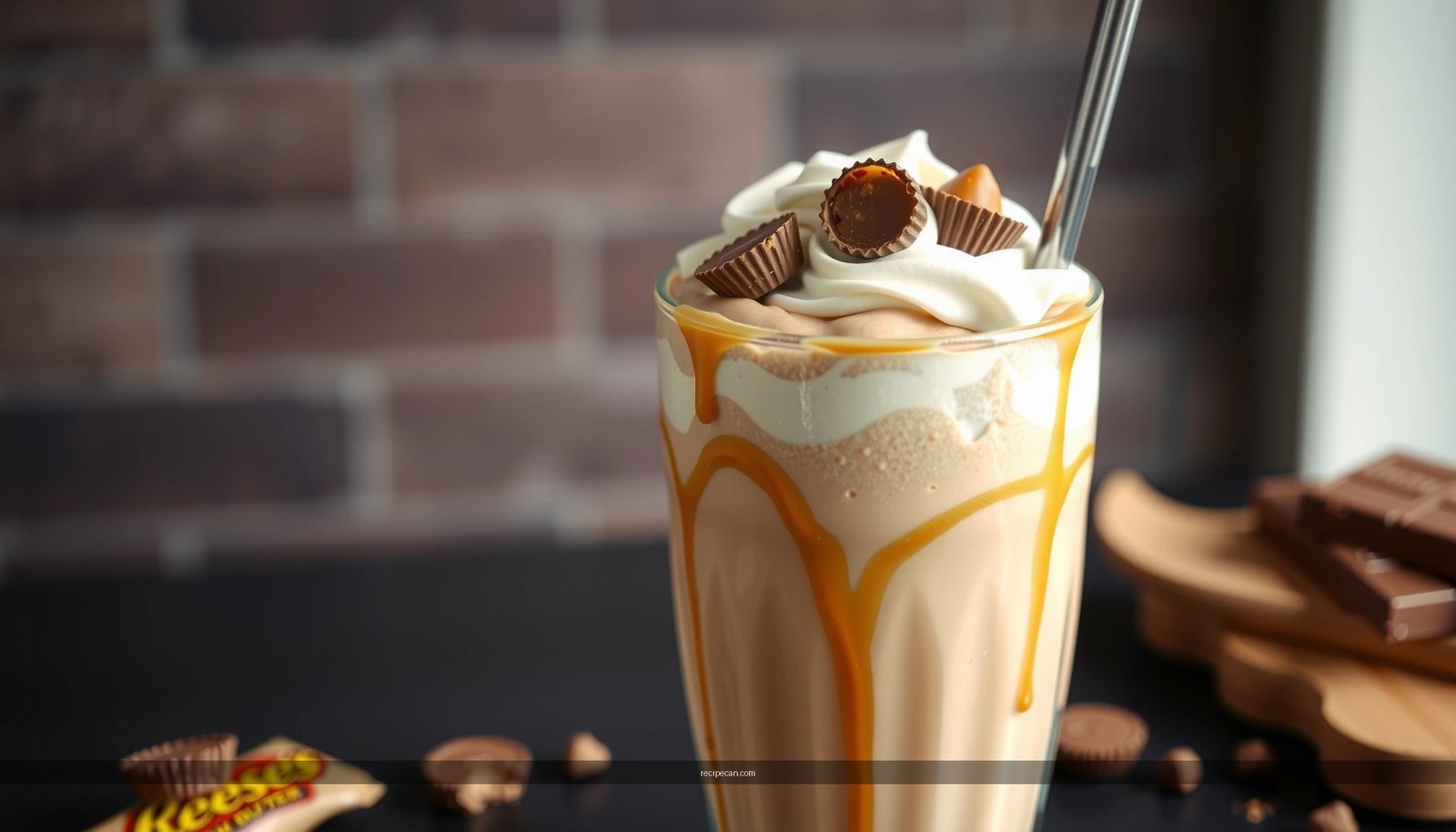
Get the thick, creamy Reese’s peanut butter milkshake recipe that delivers real milkshake texture in minutes, not a watery blend. This step-by-step method answers whether you can make a restaurant-style Reese’s peanut butter milkshake at home—and yes, you can. Use the right ingredient ratios and mixing tips to get a rich, spoon-thick shake every time.
Make a thick, creamy Reese’s peanut butter milkshake by blending cold milk, peanut butter, vanilla ice cream (or vanilla milkshake base), and crushed Reese’s cups—then fine-tune texture with small, deliberate additions. You’ll get the classic rich flavor and smooth spoonable consistency by adding the candy during blending (for even distribution) and calibrating thickness with the right “milk vs. ice” balance.
Ingredients You’ll Need for a Reese’s Peanut Butter Milkshake
To make an authentic Reese’s-style milkshake, treat ingredients like a system: peanut butter provides body and flavor, dairy provides creaminess, and crushed Reese’s cups add chocolate-peanut crunch that melts into the shake.
– Peanut butter (and/or Reese’s peanut butter cups) for signature flavor
Use creamy peanut butter for the smoothest texture. Peanut butter contributes fat and emulsifiers that help your shake stay thick and cohesive instead of tasting “watery.” Reese’s cups add both peanut and chocolate notes, plus small bits of candy that blend into a richer, more dessert-like mouthfeel.
– Milk and vanilla ice cream to achieve the right creamy thickness
Whole milk typically yields the best flavor and thickness. Vanilla ice cream is the easiest path to a thick shake because it already contains dairy fat and stabilizers. If you prefer a “milkshake base,” choose one that’s designed for blending so the result thickens without long resting.– Optional whipped cream and extra chopped cups for topping
Toppings don’t just look better—they also protect texture. Whipped cream adds a light, airy contrast to a thick shake, while chopped Reese’s cups create controlled crunch instead of fully blending into sweetness.
Milkshake Texture Targets by Ingredient Choice
| # | Ingredient Strategy | Best For | Texture Score | Outcome |
|---|---|---|---|---|
| 1 | Cold vanilla ice cream + whole milk | Classic thick shake | 9/10 ★★★★★★★★★ | Highly thick |
| 2 | Add Reese’s cups during blending | Even flavor distribution | 8/10 ★★★★★★★★ | Smooth + rich |
| 3 | Use creamy peanut butter (not natural) | Minimal separation | 8/10 ★★★★★★★★ | Consistent body |
| 4 | Blend longer (30–45 sec) | No grit, no chunks | 8/10 ★★★★★★★★ | Smoother texture |
| 5 | Too much milk early (then try to fix) | High risk of thinning | 5/10 ★★★★★ | Can become runny |
| 6 | Add ice in small increments | Body without dilution | 8/10 ★★★★★★★★ | Thickens safely |
| 7 | Rest 10+ minutes before serving | Convenient prep | 6/10 ★★★★★★ | Thickens too much |
Step-by-Step: How to Make It (No-Fail Method)
A “no-fail” Reese’s peanut butter milkshake recipe comes down to blending order and quantity control. If you control those two variables, the rest becomes repeatable.
– Blend milk, peanut butter, and ice cream until smooth and thick
Start with milk + peanut butter, then add vanilla ice cream. Blend until the base looks uniform—no visible streaks of peanut butter. This ensures emulsification, which helps your final shake stay thick and creamy rather than oily or separated.
– Add crushed Reese’s cups during blending for even flavor throughout
Crush Reese’s cups into smaller pieces (lightly; you don’t need dust). Add them partway through blending or add them right at the start if your blender is strong. Either way, blending ensures the chocolate-peanut flavor disperses evenly, rather than sinking or clumping at the bottom.
– Adjust with a splash more milk if you want it thinner
If your shake is too thick to drink with a straw, add milk one tablespoon at a time. Conversely, if it’s too thin, use the opposite lever (ice cream or ice). Small adjustments prevent the common problem of “over-correcting,” which makes thickness swing wildly.
Practical “Blend Logic” (the method behind the method)
For best texture, aim for a shake that looks like thick soft-serve while still moving in the cup. If it’s already standing in peaks after blending, you’re too thick for immediate drinking—fix it with a teaspoon of milk, not a big pour.
How to Get the Perfect Thickness
Thickness is influenced by fat content, temperature, and particle size. The goal is to balance those factors so the shake feels thick but still blends smoothly.
– Use colder ice cream and blend longer for a thicker shake
Cold ice cream partially freezes the mixture while blending creates a finer texture. Blending longer (typically **30–45 seconds**) helps break down candy pieces and improves the “silky” texture people expect from a classic Reese’s peanut butter milkshake.– Add ice (small amounts) if your milkshake needs more body
If your shake becomes runny—often because the ice cream wasn’t cold enough—adding ice increases viscosity without adding much flavor. Add 1–2 ice cubes at a time, then blend again. This is especially useful if you don’t want to increase sweetness by adding more candy.
– Keep a quick “add milk vs. add ice” balance for consistency
Think of it like this:
– Too thick? Add a tiny splash of milk.
– Too thin? Add a few cubes of ice and blend.
– Still not right? Repeat once more rather than changing multiple variables at once.
Ingredient ratios that consistently work (for thick, spoonable results)
A thick Reese’s-style milkshake generally benefits from slightly more ice cream than milk. If you’re using a standard blender and want it thick like a shop version, keep milk modest and let crushed cups do some of the “body work” by dispersing through the blend.
Flavor Boosters and Mix-In Ideas
Once you nail the base, flavor becomes your playground. The best boosters enhance peanut-butter-forward taste without turning the shake into something overly sweet or too salty.
– Use crushed Reese’s cups for texture and extra peanut butter flavor
Crushed cups give you both chocolatey depth and peanut butter hits. For a richer flavor profile, consider adding one extra spoonful of peanut butter alongside the cups—this strengthens the peanut taste even when the chocolate is prominent.
– Try a pinch of salt or a little extra vanilla to deepen taste
A tiny pinch of salt can make sweetness taste more “rounded” instead of flat. Likewise, a touch more vanilla can bring forward the creamy dairy notes, making the shake taste less one-dimensional.
– Optional chocolate drizzle for a richer dessert vibe
If you want “copycat milkshake shop” energy, drizzle chocolate syrup on the inside of the cup before pouring. Then add chopped cups on top. The drizzle provides a clear chocolate note that contrasts the peanut butter.
Suggested add-ins (choose one category at a time)
– Extra peanut: +1 tablespoon peanut butter
– Extra crunch: sprinkle chopped Reese’s on top (hold back from blending if you want larger pieces)
– Extra chocolate: a thin drizzle plus a few shaved pieces
Serving and Storage Tips
Milkshakes are best at the moment of perfect consistency. Serve smartly and storage becomes a non-issue.
– Serve immediately with whipped cream and chopped Reese’s on top
Once blended, the texture is at its peak. Add whipped cream and chopped cups right before serving to preserve contrast—creamy, airy, and crunchy in one bite.
– For best texture, store in the fridge only briefly (it thickens as it chills)
Refrigeration increases thickness because fats and sugars firm up. If you must store it, keep it short—think “a brief window,” not “later tonight.”
– Stir well before serving if it thickens after refrigeration
If it becomes too thick, stir aggressively to re-incorporate. If needed, add a teaspoon or two of milk and stir again (or blend briefly for a second to restore smoothness).
Serving tip for “thicker but drinkable”
Use a spoon-friendly cup with a wide surface area. Even if the shake is thick, presentation cues can make it feel less “hard” and more dessert-like.
Troubleshooting Common Issues
Even when you follow a recipe, real-world variables (blender power, room temperature, how soft the ice cream is) can change outcomes. Use these targeted fixes to recover quickly.
– Too thin? Add more ice cream or ice and blend again
Don’t just add more milk to “even it out”—that usually worsens thinness. Instead:
– Add a scoop of ice cream, or
– Add a few ice cubes, then blend.
– Not sweet enough? Add an extra spoon of peanut butter or a few more cups
Sweetness can vary by the brand of milk, ice cream, and peanut butter. To correct, boost flavor concentration with peanut butter or add more Reese’s cups, then blend briefly to integrate.
– Lumpy? Ensure cups are chopped/crushed and blend longer
Lumps usually come from candy pieces that are too large for your blender. Crush more thoroughly next time and blend longer now. If you still see chunks, stop once and scrape down the sides before blending again.
Quick diagnostic checklist
– Runs fast and looks shiny → too much milk or warm ingredients
– Sandy texture → pieces too large or insufficient blending time
– Separated look → peanut butter not blended into the milk before adding ice cream
A Reese’s peanut butter milkshake is easiest when you blend peanut butter, ice cream, and Reese’s cups until smooth, then tweak thickness with a little milk or ice. Make it your own with toppings and mix-ins, and whip up a batch today—then share your favorite version!
References
- Google Scholar Google Scholar
https://scholar.google.com/scholar?q=reese%27s+peanut+butter+milkshake+recipe - Google Scholar Google Scholar
https://scholar.google.com/scholar?q=peanut+butter+milkshake+recipe+technique - Google Scholar Google Scholar
https://scholar.google.com/scholar?q=milkshake+nutrient+composition+peanut+butter+ingredients - Reese’s Peanut Butter Cups
https://en.wikipedia.org/wiki/Reese%27s - Milkshake
https://en.wikipedia.org/wiki/Milkshake - Peanut butter
https://en.wikipedia.org/wiki/Peanut_butter - https://www.britannica.com/topic/milkshake
https://www.britannica.com/topic/milkshake - https://www.who.int/publications/i/item/9789241549028
https://www.who.int/publications/i/item/9789241549028 - https://www.cdc.gov/nutrition/data-statistics/added-sugars.html
https://www.cdc.gov/nutrition/data-statistics/added-sugars.html - https://pubmed.ncbi.nlm.nih.gov/
https://pubmed.ncbi.nlm.nih.gov/