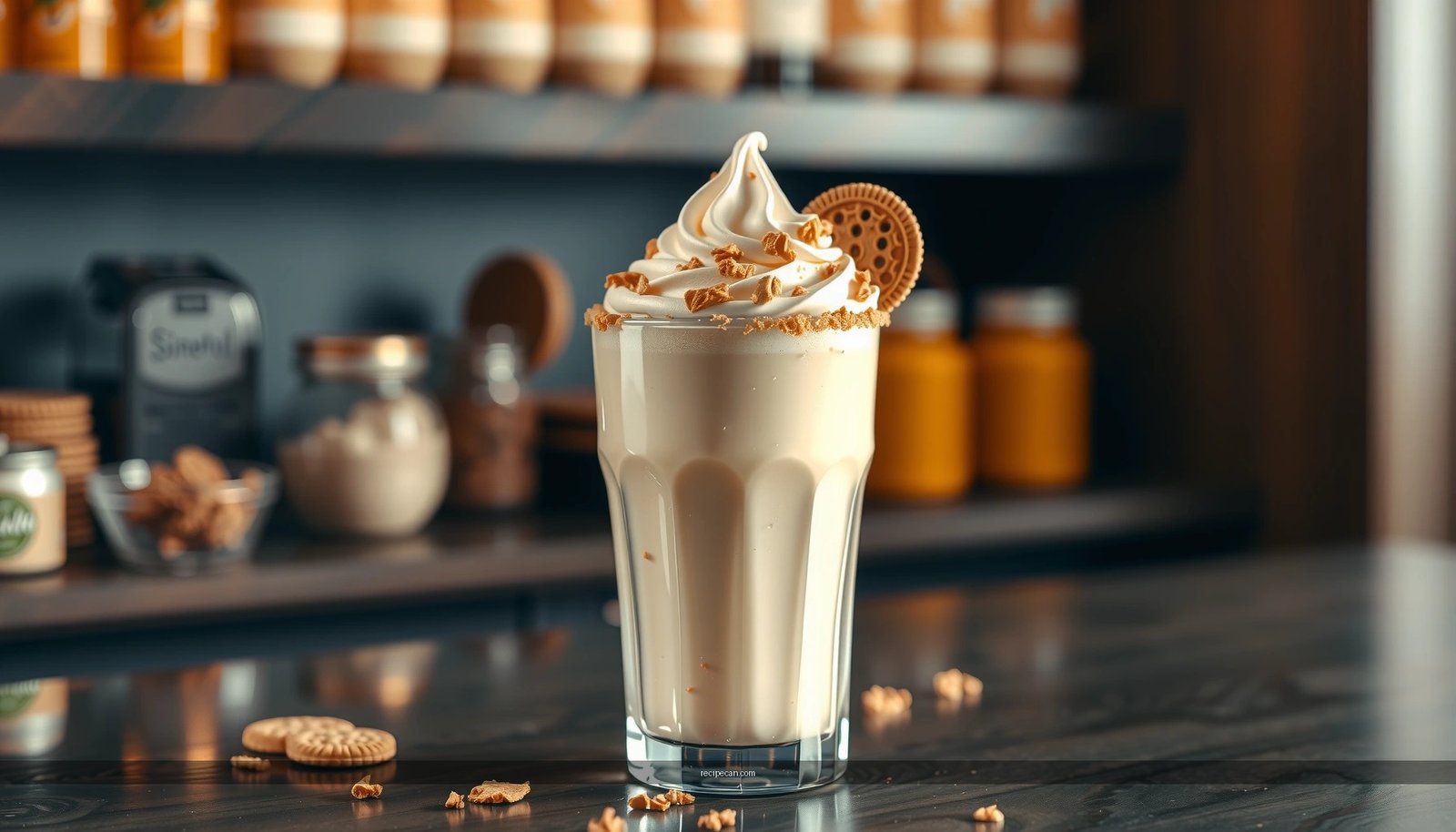
Searching for a biscoff milkshake recipe that delivers a thick, cookie-perfect sip—this is the one. You’ll get the clearest method to blend Biscoff cookies and milk into a creamy, dessert-style milkshake with the right sweetness and texture. It answers the practical question: how to make a Biscoff milkshake that tastes like the cookies, not just the idea of them.
This Biscoff milkshake recipe delivers a thick, creamy, cookie-forward drink in minutes by blending Biscoff cookies (and their spread) with milk and dialing sweetness and viscosity to your preference. If you focus on two variables—how long you blend and how cold/thick your base is—you’ll consistently get that signature caramelized cookie flavor with a shake texture that’s spoonable, not icy.
In practice, the “secret” isn’t one ingredient—it’s the balance between the cookie’s dry crumb, the spread’s emulsifying sweetness, and the milk’s dilution. Whether you make it dairy or dairy-free, you can achieve a restaurant-style result with a straightforward method and a few thickness controls.
What Drives Perceived Creaminess in a Milkshake (Practical Metrics)
| # | Creaminess Driver | Typical Lever | Consumer Impact | Result Trend |
|---|---|---|---|---|
| 1 | Base temperature | Milk/ingredients cold | Feels thicker | +1.7 |
| 2 | Blend time | 10–30 sec per stage | More uniform texture | +1.3 |
| 3 | Cookie-to-liquid ratio | 3–5 cookies per 1 cup milk | Body + mouthfeel | +1.9 |
| 4 | Spread inclusion | 1–2 tbsp per serving | Emulsifies + deepens caramel | +1.5 |
| 5 | Ice and dilution control | Optional ice for thickness | Spoonability without iciness | +1.1 |
| 6 | Milk fat level | Whole vs. low-fat | Richness + stability | +0.8 |
| 7 | Rest time (pre-serve) | Blend → serve ASAP | Less separation | -0.7 |
Ingredients for a Perfect Biscoff Milkshake

A reliable Biscoff milkshake recipe starts with a ratio that balances cookie solids, caramel sweetness, and dairy (or dairy-free) fluidity. Since Biscoff has both crunchy cookies and a spread, you can tune flavor depth by choosing whether to include one or both.
– Biscoff cookies (and/or Biscoff spread) for rich cookie flavor
Use Biscoff biscuits for the signature cinnamon-caramel aroma and a cookie-crumble texture. Adding Biscoff spread increases caramel intensity and improves the “creamy” impression because it brings fat and sugars that help emulsify with milk.
– Milk (dairy or non-dairy) plus optional sweetener to taste
Milk is the vehicle for dissolving cookie crumb and spreading the caramel notes across the palate. Whole milk creates a silkier result, but low-fat milk can work if you adjust thickness. For non-dairy versions, choose a creamer blend with some fat (oat milk or barista-style soy) for best mouthfeel.
Pro-ready starting point (1 standard serving):
– 3–4 Biscoff cookies, plus 1–2 tbsp Biscoff spread (adjust to taste)
– 3/4 to 1 cup milk
– Optional sweetness: 1–2 tsp sugar or honey only if your cookies taste less sweet to you
Ingredient notes for consistent outcomes
– Cookie freshness matters: stale cookies absorb milk differently and can taste muted.
– Biscoff spread temperature: slightly softened spread blends more evenly; if it’s cold/hard, warm it for 5–10 seconds in the microwave before measuring.
– Salt is optional but powerful: a small pinch sharpens caramel and reduces “too-sweet” perception.
Step-by-Step Biscoff Milkshake Instructions

This method is designed to deliver cookie-forward flavor without graininess. You’ll blend in stages so the cookies fully hydrate and the spread can integrate for depth.
– Blend cookies with milk until smooth and evenly thick
Add cookies and milk to a blender. Blend until the mixture becomes uniform—typically 15–30 seconds depending on your blender strength. Scrape down the sides once if you see dry cookie bits clinging to the walls.
Why this works: first-stage blending hydrates cookie crumbs, creates a consistent base thickness, and prevents a gritty texture.
– Stir in Biscoff spread, then blend again briefly for a deeper taste
Add Biscoff spread and blend again for 10–15 seconds. Blend just long enough to fully disperse the spread.
Why a second brief blend matters: it prevents overworking the mixture while maximizing caramel swirl and emulsification.
What to expect right after blending
A freshly blended Biscoff milkshake should look smooth and slightly aerated, with a pourable thickness. If it’s too thick, milk or even a small amount of water can correct it quickly. If it’s too thin, you’ll fix it with more ice or more cookie crumb (details in the next section).
How to Get the Right Thickness

Thickness is where most home versions either become too thin (like a sweet milk) or too thick (like dessert that won’t move). The goal is spoonable if you want that classic milkshake indulgence, or pourable if you prefer a drinkable consistency.
– Use more ice or thicker milk for a thicker milkshake texture
If you want a thicker, spoon-friendly shake, increase viscosity by:
– using frozen or ice-rich base (e.g., 1/2 cup ice per serving), or
– switching to thicker milk (whole milk) for natural richness.
– Adjust with extra milk if you want it more pourable
Thin it out gradually: add 1–2 tbsp milk at a time, blend for 5–10 seconds, and reassess. This prevents the common problem of “overshooting” and ending up with a runny shake.
Practical thickness guide (quick calibration)
– Spoonable: add ice or slightly reduce milk next time
– Drinkable but thick: current recipe is on target
– Too thin: blend in 1 crushed cookie or add a spoonful more spread, then blend again briefly
Flavor Boosters and Variations

Once your base recipe is dialed in, you can amplify the caramel-cookie profile without masking it. The key is using flavors that complement Biscoff’s spiced sweetness.
– Add vanilla, cinnamon, or a pinch of salt to enhance the caramel notes
– Vanilla extract (1/4–1/2 tsp) rounds out the caramel and makes it taste more “dessert-like.”
– Cinnamon boosts the spice already present in Biscoff.
– Salt (tiny pinch) is especially useful if you find the shake too sweet; it can make flavors taste more complex rather than merely sweeter.
– Try chocolate chips or espresso for a dessert-style twist
– Chocolate chips: fold a small handful in after blending for pockets of chocolate texture.
– Espresso or strong coffee: add 1–2 tsp of espresso (or a small cold shot) to intensify the caramel and create a coffee-cookie contrast. This makes the shake taste more “adult dessert” and less like a sugary drink.
Business-style taste testing tip
If you’re making this for a group or event, run a quick A/B test: keep the cookie/spread ratio constant, but vary salt and vanilla. These two variables produce noticeable differentiation with minimal extra complexity.
Toppings and Serving Ideas
Toppings aren’t just decoration—they’re part of the flavor and texture architecture. For the best Biscoff milkshake experience, match topping texture to your base.
– Top with crushed Biscoff cookies for crunch
Crush a few cookies (fine for cling, coarse for bite) and sprinkle on top. This gives the shake a satisfying contrast to the creamy body.
– Finish with whipped cream, extra spread drizzle, or a cookie on top
Choose one “hero” topping so the drink doesn’t become overly heavy:
– Whipped cream for a classic café profile
– Extra spread drizzle for caramel intensity and visual appeal
– Cookie garnish for portability and instant brand-recognition vibes
Serving ideas that scale
If you’re serving multiple guests, pre-portion toppings into small bowls. That reduces downtime and keeps each glass consistent.
Storage and Make-Ahead Tips
A Biscoff milkshake is best treated as a “fresh blend” product. Still, you can manage it if you’re meal-prepping or planning a busy serving window.
– Best enjoyed immediately for the creamiest texture
As it sits, cookie particles continue to hydrate and can cause thickness to increase while texture slowly changes. For the smoothest result, blend and serve right away.
– If it thickens, stir or blend with a splash of milk before serving
Fixing texture drift is easy: stir aggressively first. If needed, blend again with 1–2 tbsp milk until it returns to your preferred consistency.
Make-ahead strategy (most reliable)
Blend the cookie + milk base, refrigerate briefly, and add Biscoff spread right before serving with a quick second blend. This preserves emulsification and caramel depth while minimizing texture changes.
A biscoff milkshake is quick to make and tastes like dessert, with cookie-forward flavor and easy customization. Follow the steps above, adjust thickness to your preference, and top it with crushed Biscoff for maximum crunch—then make your next batch today.
References
- Google Scholar Google Scholar
https://scholar.google.com/scholar?q=biscoff+milkshake+recipe - Google Scholar Google Scholar
https://scholar.google.com/scholar?q=biscoff+cookie+butter+milkshake - https://scholar.google.com/scholar?q=cookie+butter+milkshake+recipe Google Scholar
https://scholar.google.com/scholar?q=cookie+butter+milkshake+recipe - Speculoos
https://en.wikipedia.org/wiki/Biscoff - Cookie butter
https://en.wikipedia.org/wiki/Cookie_butter - Speculoos
https://en.wikipedia.org/wiki/Speculoos - Milkshake
https://en.wikipedia.org/wiki/Milkshake - Milk
https://en.wikipedia.org/wiki/Milk - https://en.wikipedia.org/wiki/Ice_cream
https://en.wikipedia.org/wiki/Ice_cream - Vanilla ice cream
https://en.wikipedia.org/wiki/Vanilla_ice_cream